

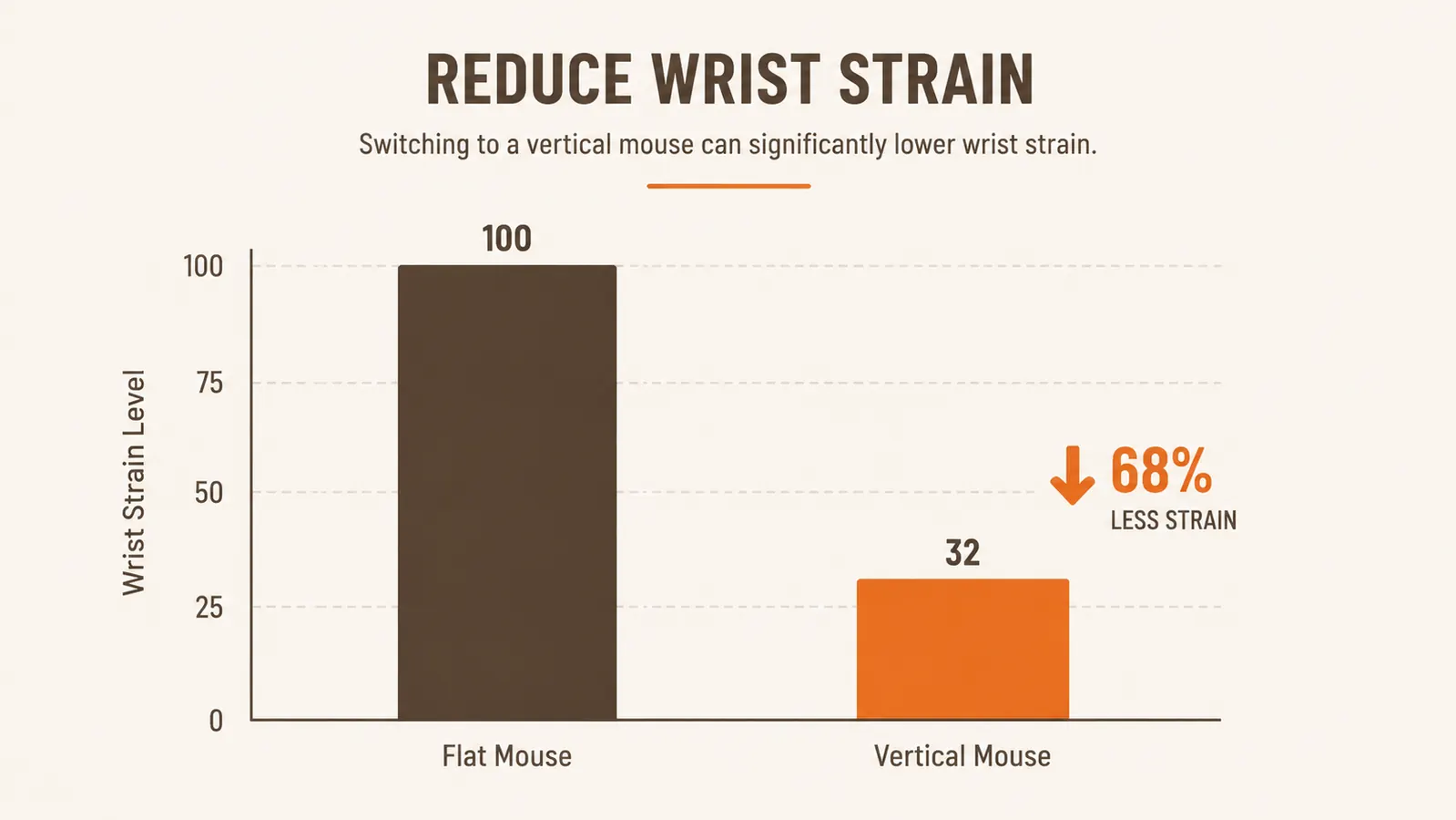
My right wrist used to start aching by two in the afternoon, every single day, from nine years of parking a flat mouse next to my keyboard in my spare bedroom in Boise. I blamed my keyboard angle. I blamed my chair. I even reorganized my whole desk once, which tells you how far I was reaching for an answer. The thing I never questioned for years was the mouse itself, sitting there flat under my palm, twisting my forearm the same direction for eight hours straight. Once I switched to a vertical mouse, a Logitech Lift I picked mostly because it was the one my optometrist's office had sitting out on their own front desk, that afternoon ache mostly stopped.
I'm not a doctor and none of this is medical advice, just what changed for a technical writer who has worked from a spare bedroom for nine years and has sat through every bad desk decision a person can make. A flat mouse forces your forearm to rotate inward and hold that twist for hours at a time, and a vertical mouse lets your hand rest in something closer to a handshake position instead. Here are the ten reasons a vertical mouse like the Logitech Lift eased the wrist strain that had been building up for years at my desk. I wrote a longer walkthrough of how I actually set mine up here: Logitech Lift review after five months of daily use.
Stop blaming your desk setup for pain your mouse is actually causing
Most wrist and forearm ache at a computer doesn't come from typing. It comes from a mouse that keeps your forearm twisted the same direction for hours. See today's price on the Logitech Lift and check current availability.
Amazon Check Today's Price on Amazon →It takes the twist out of your forearm
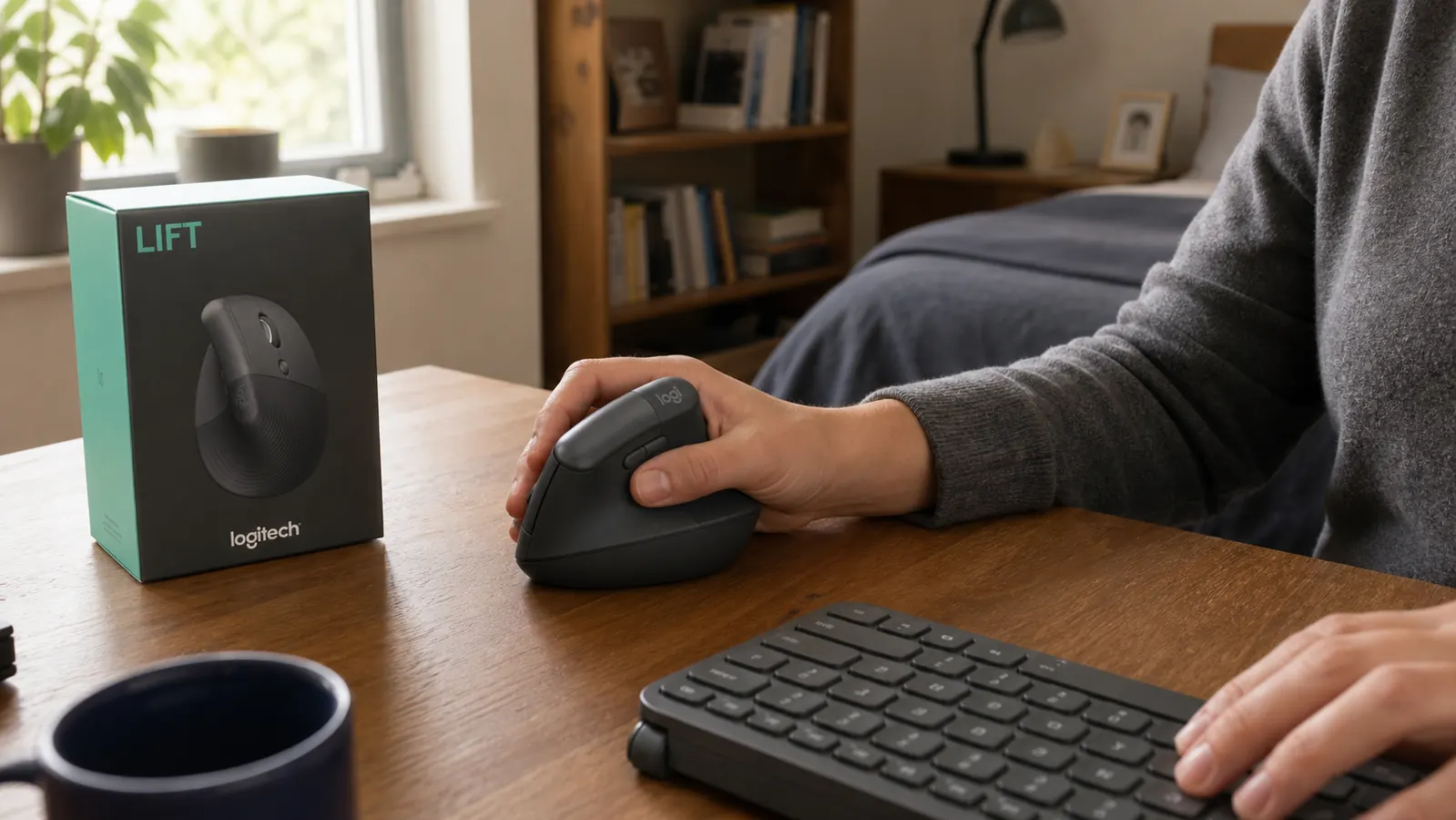
A regular mouse sits flat, which means your palm faces down and your forearm has to rotate inward to hold that position for hours. That rotation, called pronation, is where a lot of desk wrist pain starts. A vertical mouse tilts the grip roughly 90 degrees so your hand rests in more of a handshake position, thumb up instead of palm down. The Logitech Lift is built around that angle specifically, and it was the single biggest change I noticed switching mice. For the full breakdown, see my long-term Logitech Lift review.
It gives your thumb a natural resting spot
Flat mice put your thumb on the side of the mouse in an awkward, slightly cramped position, which adds up over a full workday of clicking and dragging. A vertical mouse shape puts a contoured rest right where your thumb naturally falls when your hand is upright. On the Logitech Lift there's a dedicated thumb rest, and I noticed within the first week that my thumb wasn't cramping by the afternoon the way it used to.
It shortens the reach across your desk
A smaller, more compact vertical mouse body sits closer to your keyboard than a lot of bulky flat mice, which means less shoulder and forearm reach every time you move between typing and clicking. That shorter reach doesn't sound like much, but repeated hundreds of times a day, it's less overall movement your wrist and shoulder have to make.
It cuts down on repetitive micro-strain from clicking
The click buttons on a vertical mouse sit under your fingers in a more relaxed position, since your hand is already upright instead of flattened. That means less finger tension per click, which matters when you're clicking hundreds of times an hour during a normal workday. On the Logitech Lift, the clicks are also noticeably quieter and lighter than a standard mouse, which I didn't expect to matter but did.
It pairs well with lowering your whole arm angle
Once your hand is upright instead of flat, it's easier to also lower your elbow and shoulder into a more relaxed position, since you're no longer compensating for a twisted wrist by raising your arm. I ended up lowering my desk about half an inch after switching mice, and the two changes together made more difference than either one alone. I wrote a full guide to getting the angle right here: how to fix wrist pain with a vertical mouse.
Customizable buttons mean fewer awkward reaches
A lot of repetitive strain isn't from the mouse itself, it's from reaching for the keyboard to copy, paste, or switch windows over and over. The Logitech Lift has four programmable buttons, so I mapped copy, paste, and back to the mouse itself. Fewer trips back to the keyboard means fewer repeated wrist movements across a full day.
It's quiet enough that late nights don't wake anyone up
This one is unrelated to wrist pain directly, but it mattered for me. My desk sits in a spare bedroom right next to where my wife sleeps, and a loud clicky mouse at 10pm was its own small daily friction. The Logitech Lift uses quiet clicks, which meant working late didn't come with an apology the next morning, and I actually used it more consistently because of that, which is where the wrist benefit compounds.

Long battery life means you actually keep using it
An ergonomic mouse only helps your wrist if you're using it, and a mouse that's dead in your desk drawer isn't helping anyone. The Logitech Lift runs for months on a single charge in my experience, which means I've never had a week where I dug the old flat mouse back out because the new one needed charging.
It works across the devices you actually switch between
A lot of desk setups now involve a laptop, a second monitor, and sometimes a tablet, and constantly swapping input devices between them adds friction that makes people skip the ergonomic option out of convenience. The Logitech Lift pairs over Bluetooth or a small USB receiver and can switch between a couple of paired devices, so it stayed my main mouse instead of getting left behind for whichever machine happened to be closer.
It's a one-time fix, not something you have to manage every day
Stretching your wrist helps. Taking breaks helps. But those are things you have to remember to do, every single day, forever. A vertical mouse is a fix you set up once and then just use. I'm not great at remembering to stretch on a deadline day, and a vertical mouse doesn't require me to be.
The mouse I'd never once questioned turned out to be the thing quietly causing the ache I kept blaming on my keyboard and my chair.
What I'd Skip
I'd skip any mouse that calls itself ergonomic just because it has a slight curve to the plastic. That's not the same thing as a true vertical mouse built around the handshake grip angle. A lot of cheaper options tilt maybe 20 degrees, which barely changes your forearm position at all. The Logitech Lift tilts around 57 degrees, which is close to a real neutral wrist position, and that difference is the whole reason a vertical mouse works in the first place.
I'd also skip expecting it to feel natural on day one. The Logitech Lift felt strange for about the first week, since my hand had years of muscle memory built around a flat grip. I nearly went back to my old mouse twice before it clicked. Give any vertical mouse a real week of daily use before deciding whether it's working, because the adjustment period is normal and it does pass.
Your wrist doesn't need more stretch breaks, it needs a mouse that isn't twisting it all day
If you've tried everything else and the afternoon ache still shows up like clockwork, check today's price on the Logitech Lift and see if it's in stock.
Amazon Check Today's Price on Amazon →