

Nine years into writing documentation for a living, I did not expect the problem to show up in my hands. My back complained early and my neck complained a little later, but somewhere around year six it was my right wrist that started talking to me first, a dull tingling that ran from my palm up through my forearm by the end of a long writing day. I ignored it the way I ignore most things until they get loud, which turned out to be a mistake, and it is the reason I ended up trying a Logitech Lift vertical mouse instead of just pushing through with the same flat mouse I had used since college.
The tingling started small. I noticed it mostly on days when I was deep in a long technical spec, the kind of writing where you do not look up for two hours because you are trying to hold an entire system in your head. My hand stayed curled around the mouse the whole time, wrist bent flat against the desk, and by the time I finally looked up my fingers felt stiff in a way that took a few minutes to shake out. I told myself it was normal for the job. Most technical writers I know complain about something similar, so I filed it under the cost of doing business and kept typing.
By year eight it was not staying small anymore. I would wake up some mornings with my hand feeling asleep before I had even touched a keyboard, and I started shaking it out in the shower, which is not something you want to be doing at forty. I mentioned it at a regular checkup, more as a passing comment than a real complaint, and got asked how I held my mouse. I demonstrated at the counter, wrist flat, forearm twisted so my palm faced straight down toward the desk. That twist, held for hours a day, every day, for years, was apparently doing at least as much work as the keyboard.
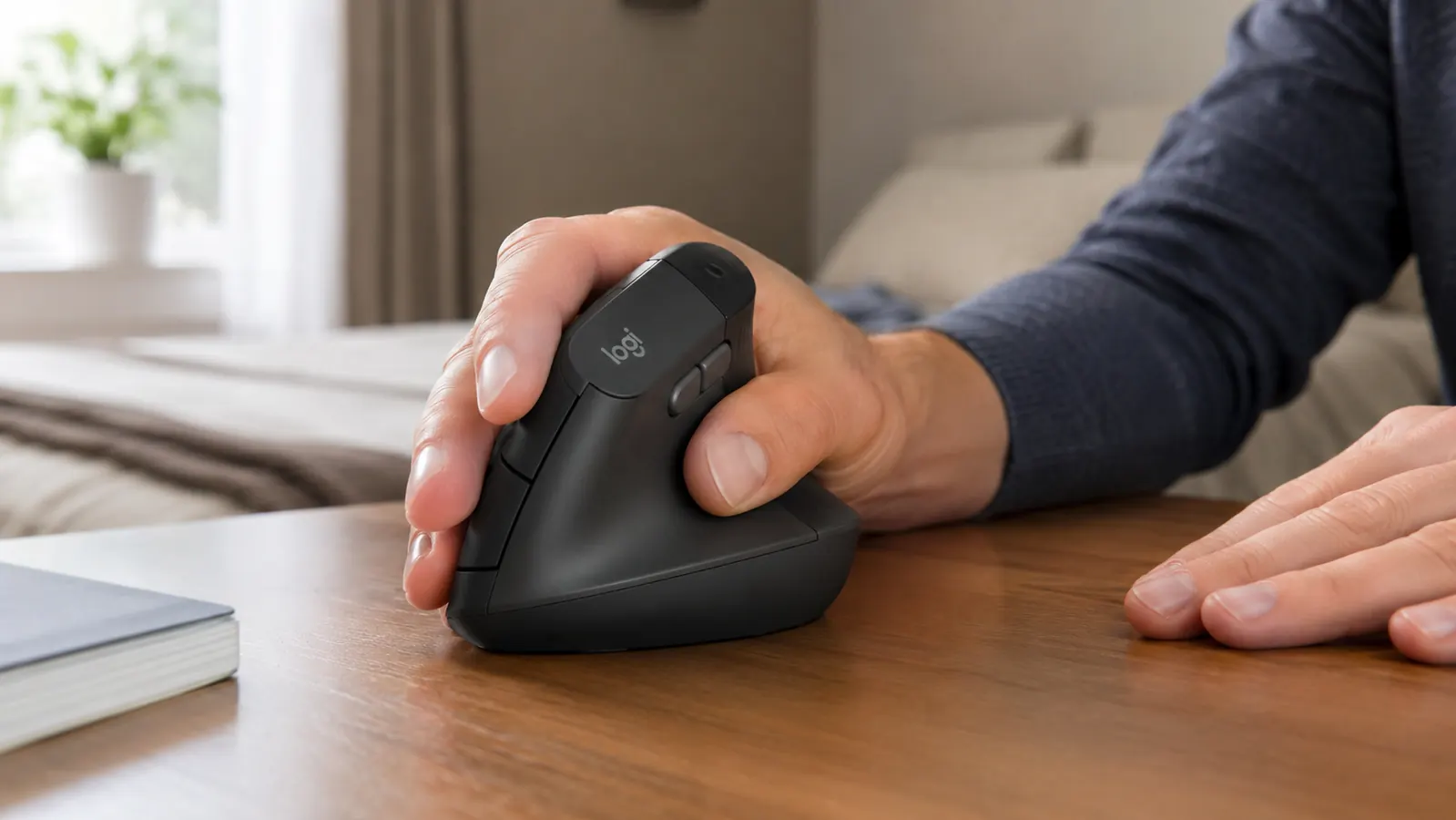
That was the push I needed to finally look at a vertical mouse instead of just switching hands or taking more breaks I would forget to take. I had seen the Logitech Lift recommended in a couple of ergonomics threads I followed, and what got my attention was the angle, close to 57 degrees, built so your hand rests more like a handshake than a flat clamp. I ordered one on a Thursday and it showed up before the weekend, small enough that it did not look nearly as strange next to my keyboard as I expected a vertical mouse to look.
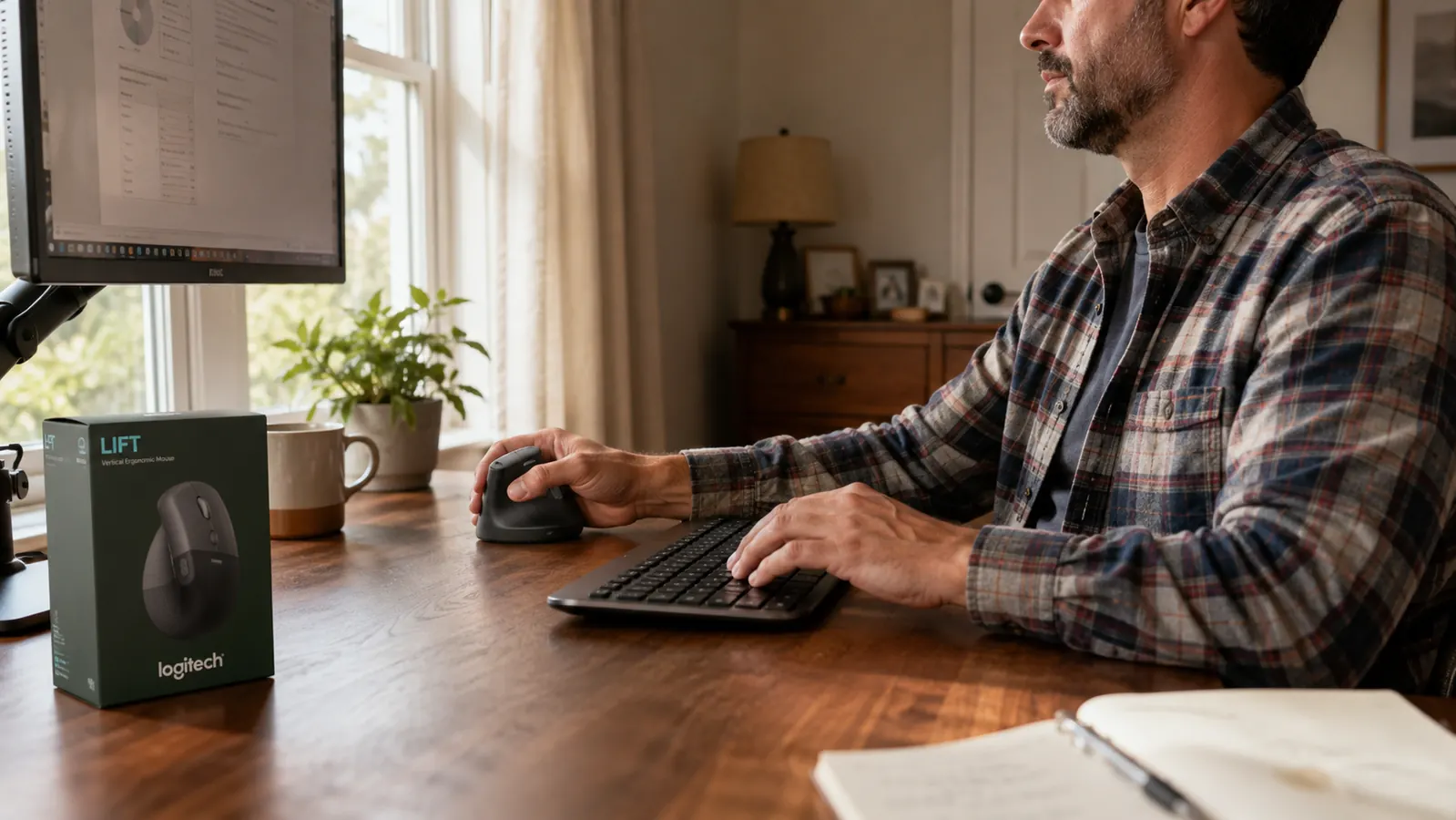
The first afternoon with it was awkward. My hand kept wanting to flatten back out of habit, and I missed a few clicks reaching for buttons that were not where my old mouse had them. By the second day the angle stopped feeling like a trick and started feeling more like how a hand is actually supposed to sit. I remember typing up a release note that afternoon and realizing I had gone almost two hours without shifting my wrist around to get comfortable, which had not happened in years.
I had spent nine years thinking the tingling in my hand was just part of the job. It was not part of the job. It was part of how I was holding the mouse.
A Flat Mouse Held the Same Way for Nine Years Adds Up
The Logitech Lift tilts your hand to a natural handshake angle instead of pinning your wrist flat all day. Check today's price on Amazon and see if the angle fits your hand the way it fit mine.
Amazon Check Today's Price on Amazon →It took about three weeks before I stopped thinking about the mouse at all, which is usually the sign that something has actually changed rather than just feeling new. The morning stiffness did not vanish overnight, but it thinned out, the way a bruise fades instead of disappearing all at once. I noticed it most on the days I had a long writing sprint ahead of me, the exact days that used to leave my hand aching by dinner.
I wrote up the longer version of those first several months in a separate review of the Logitech Lift after four months of daily use, because a few weeks of relief is not the same as proof that something holds up. The short version is that it did. I still reach for it every single workday, and I have mostly stopped noticing the vertical angle at all, the same way you stop noticing a good pair of shoes once they are broken in.

It is not a perfect mouse. It took my hand longer to adjust than I expected, closer to three weeks than the two or three days some reviews promised, and the scroll wheel has a looser feel than I would like on long scrolls through a document. I wrote about those specific annoyances in my honest review of the Logitech Lift, because a story like this one is more useful if you also know where it did not impress me.
What changed the most was not really the mouse itself, it was how I stopped bracing for the ache. I used to plan long writing days around when my hand would start bothering me, breaking sessions up earlier than I wanted to just to keep it from getting bad. I do not plan around it the same way anymore. Nine years into this spare bedroom office, that is a strange thing to be grateful for, but I am.
What I'd Tell You If We Were Sitting at My Kitchen Table
If you sat across from me and asked whether a vertical mouse is worth trying, I would ask you one thing first: does your hand or wrist bother you at a predictable point in the day, the same way mine used to show up right around the two hour mark? If it does, that is worth paying attention to before it turns into the kind of ache you cannot ignore. I am not a doctor and I am not going to tell you a mouse fixes everything. What I can tell you is that after nine years of holding a mouse the same flat way, every single day, switching the angle was the first thing that actually made a difference for me. The Logitech Lift is the one I reached for, and it is still the one sitting next to my keyboard today.
Nine Years of the Same Flat Grip Was the Real Problem
If your hand talks to you by mid-afternoon the way mine used to, it might not be your keyboard, it could be the angle of your mouse. Take a look at the Logitech Lift while it is in stock.
Amazon See the Logitech Lift on Amazon →